
Automate Repetitive Carton Palletizing at the End of Your Packaging Line
When primary and secondary packaging become faster, manual palletizing can quickly become the next production bottleneck.
Operators must repeatedly lift cartons, rotate them, position them, and build pallet layers throughout the production shift.
As output increases, manufacturers may need additional workers simply to prevent cartons from accumulating at the end of the line.
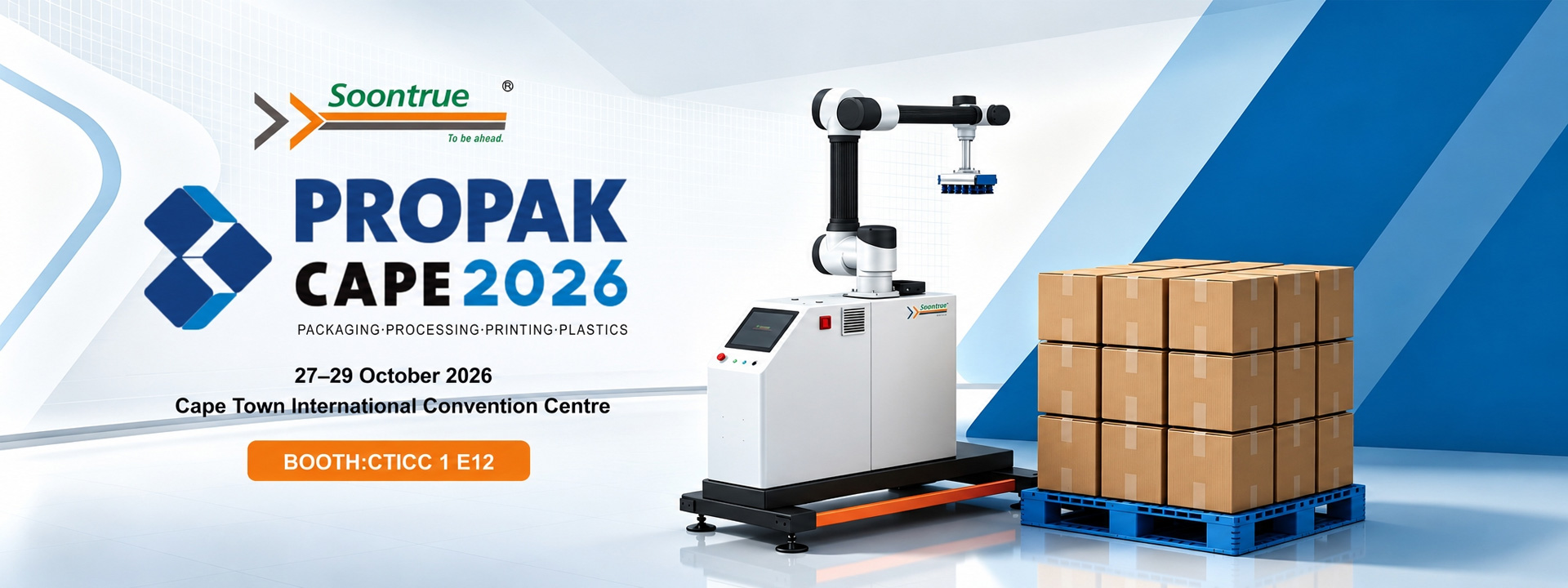
The Soontrue WP30 Robotic Palletizing System provides an automated alternative.
Visitors can explore the WP30 at Propak Cape 2026:
Hall 1, Stand E12
27–29 October 2026
Cape Town International Convention Centre, South Africa
What Is a Robotic Palletizing System?
A robotic palletizing system automatically picks finished cartons or cases from a conveyor and places them onto pallets according to a programmed stacking pattern.
The system typically combines:
- - an industrial robot;
- - carton gripping equipment;
- - conveyor systems;
- - palletizing software;
- - pallet positions;
- - safety protection;
- - control systems.
The objective is to create a repeatable process for moving finished cartons from the production line onto pallets.
For factories handling consistent carton flow, robotic palletizing can reduce the amount of repetitive physical handling required at the end of production.
Why Manufacturers Automate Carton Palletizing
Manual palletizing may work when production volumes are relatively low.
However, the situation changes as upstream packaging becomes faster.
If cartons arrive continuously, workers need to maintain the same pace for long periods.
This can create several operational challenges.
High Repetitive Workload
Workers repeatedly lift and position cartons throughout each production shift.
Inconsistent Pallet Formation
Manual stacking can vary between operators and shifts.
Labor Dependency
Higher production often requires additional labor at the end of the line.
Downstream Bottlenecks
If palletizing cannot keep pace, cartons begin accumulating after case packing or sealing.
Limited Scalability
Increasing upstream machine capacity does not automatically improve factory output if the final handling process remains unchanged.
A robotic palletizer helps manufacturers address these challenges through a more consistent automated process.
WP30 Robotic Palletizing System
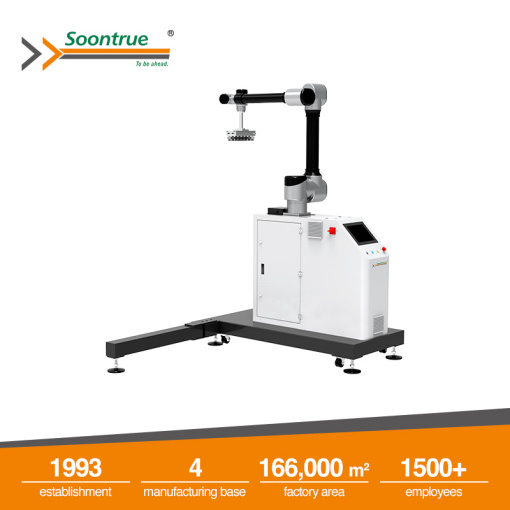
The WP30 is designed for end-of-line palletizing applications where finished cartons need to be automatically arranged and stacked.
The system can support manufacturers looking to improve:
- - carton handling;
- - pallet stacking consistency;
- - end-of-line production flow;
- - labor efficiency;
- - warehouse preparation.
Rather than operating as an isolated robot, a palletizing system should be configured according to the customer’s actual production conditions.
What Determines the Right Palletizing Solution?
There is no single palletizing configuration that fits every production line.
Several variables need to be evaluated.
Carton Size
The carton dimensions influence gripper design and pallet arrangement.
Carton Weight
Robot payload and gripping configuration must match the actual case weight.
Carton Output
The palletizer needs sufficient capacity to handle cartons arriving from upstream equipment.
Pallet Dimensions
Different markets and logistics systems use different pallet sizes.
Stacking Pattern
The pallet pattern affects pallet stability, layer configuration, and total pallet capacity.
Target Pallet Height
Robot reach and system layout must support the required stacking height.
Production Layout
Conveyors, pallet positions, safety areas, and worker access all require sufficient space.
This information should be evaluated before selecting a robotic palletizing system.
WP30 Palletizing Capacity and Flexibility
The WP30 is designed for industrial palletizing applications requiring a balance between flexibility and automated performance.
Depending on the actual project configuration, the system can support carton palletizing operations where manufacturers require reliable and repeatable downstream handling.
The WP30 platform supports:
- - carton handling for suitable production lines;
- - programmable pallet patterns;
- - automated carton positioning;
- - palletizing recipe management;
- - integration with upstream conveying systems.
For projects involving different products or carton specifications, configuration should be evaluated according to the actual case dimensions, weight, and required production rate.
Automatic Palletizing for Different Production Environments
A robotic carton palletizer can be used in different industries where products reach the end of production in standardized cartons.
Potential applications include:
Food Packaging Lines
For cartons containing packaged food, bakery products, snacks, frozen food, or other consumer products.
Beverage and Consumer Goods
For standardized secondary packaging requiring organized pallet stacking.
Industrial Production
For suitable carton-based products requiring automated end-of-line handling.
The product inside the carton is not always the main determining factor.
The palletizing system primarily needs to understand the characteristics of the finished case and production process.
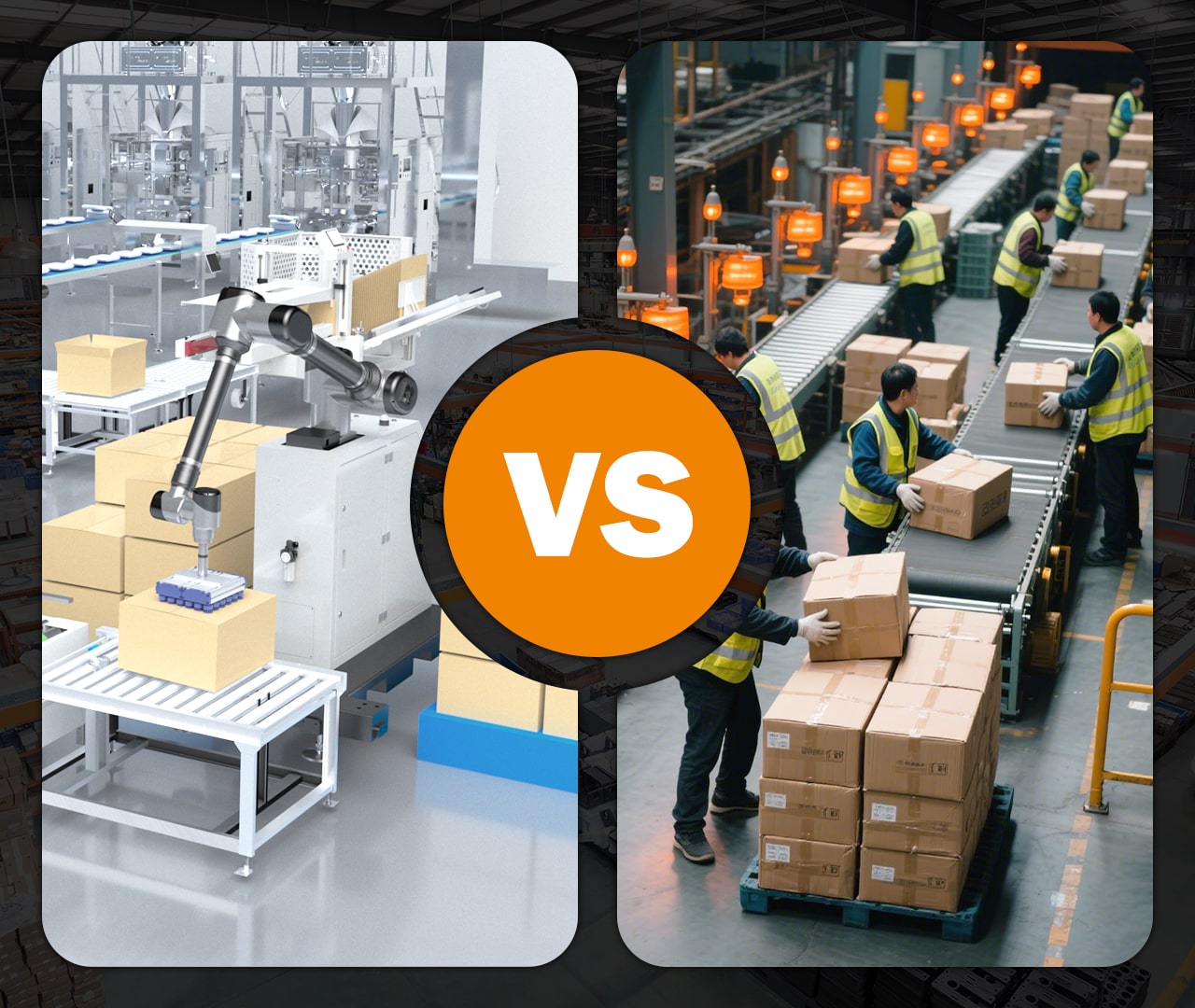
Robotic Palletizer vs Manual Palletizing
Manufacturers evaluating automation often compare robotic palletizing with manual operations.
Manual palletizing offers simplicity at low production levels but requires continuous labor.
Robotic palletizing requires equipment investment but provides a repeatable automated process.
The correct decision depends on:
- - current production volume;
- - number of operators;
- - production hours;
- - expected growth;
- - carton weight;
- - available factory space;
- - desired automation level.
Rather than assuming automation is always necessary, manufacturers should calculate whether palletizing has become a meaningful production bottleneck.
Where Does a Robotic Palletizer Fit in a Packaging Line?
The WP30 normally operates near the final stage of packaging.
A possible production flow can include:
Primary Packaging
→ Cartoning
→ Case Erecting
→ Case Packing
→ Case Sealing
→ Carton Conveying
→ WP30 Robotic Palletizing
Depending on the factory, some stages may already be automated.
This means manufacturers do not necessarily need to replace their complete production line.
A robotic palletizing system can often be evaluated as an upgrade to an existing packaging process.
Can a Palletizer Integrate with Existing Packaging Equipment?
Integration is an important consideration for any palletizing project.
Before designing a system, manufacturers should evaluate:
- - existing conveyor direction;
- - conveyor height;
- - carton orientation;
- - case spacing;
- - available signals from upstream equipment;
- - available floor space;
- - pallet loading and removal method.
Understanding these details allows the palletizing system to be designed around the current production environment.
What Information Should You Provide for a WP30 Project?
To evaluate a robotic palletizing solution, send us:
Carton Information
- - Length
- - Width
- - Height
- - Weight
Production Information
- - Cartons per minute
- - Production hours
- - Number of carton specifications
Pallet Information
- - Pallet length and width
- - Required stacking pattern
- - Maximum pallet height
Factory Information
- - Available installation space
- - Conveyor height
- - Current production layout
Photos and videos of your existing packaging line can also help our engineers better understand the project.
Frequently Asked Questions
1. What is a robotic palletizing machine?
A robotic palletizing machine automatically transfers cartons or other suitable packaged loads from a conveyor onto pallets according to programmed stacking patterns.
2. What products can the WP30 palletize?
The application is primarily determined by the finished carton dimensions, weight, production speed, and palletizing requirements rather than only the product inside the case.
3. Can the WP30 handle different carton sizes?
Different carton specifications can be evaluated according to the project. Robot reach, gripper design, pallet pattern, and system configuration need to match the required case range.
4. Can a robotic palletizer be added to an existing production line?
In many projects, palletizing automation can be integrated with existing upstream packaging and conveying equipment. The current factory layout and interface conditions should be evaluated first.
5. What information is required for a quotation?
Carton dimensions, carton weight, production speed, pallet size, pallet pattern, required stacking height, and factory layout are particularly useful for preparing a suitable proposal.
See the WP30 at Propak Cape 2026
If you are searching for:
- - robotic palletizing system;
- - automatic carton palletizer;
- - robot palletizing machine;
- - case palletizing system;
- - end-of-line packaging automation;
- - automatic pallet stacking machine;
- - carton palletizing robot;
- - palletizing automation for food factories;
meet Soontrue at Propak Cape 2026.
Hall 1, Stand E12
27–29 October 2026
Cape Town International Convention Centre
Cape Town, South Africa

Request a WP30 Palletizing Solution
Send Soontrue your carton dimensions, weight, production rate, pallet specifications, and factory layout.
Our team can evaluate your application and recommend a suitable robotic palletizing configuration.