

How to Calculate Packaging Line Capacity Before Equipment Selection
Food packaging line needs balanced performance across every stage. Slow feeding, weighing, or downstream handling can limit overall output.
Before selecting equipment, manufacturers should calculate their target capacity and ensure each stage can meet production needs.
Starting with Daily Production Targets
For example, a bakery needs to pack 48,000 products during an 8-hour shift. Assuming all 480 minutes are available for production, the required average output is:
48,000 ÷ 480 = 100 packs per minute
This is the baseline production target, not the final machine speed. Film changes, cleaning, product adjustments, and unexpected stops can reduce the time available for packaging. These factors must be considered when estimating the machine capacity required to meet daily orders.
Calculating Required Speed Under Actual Production Conditions
The rated speed of a packaging machine serves as a reference point, but it does not directly reflect the actual output a factory can achieve over the course of an entire shift.
For a preliminary estimate, use the following formula:
Required Rated Speed = Target Output ÷ (Planned Production Minutes × Expected Operating Rate)
For example: Suppose the target output is 48,000 units per shift, with a planned production duration of 480 minutes and an estimated operating rate of 80%.
48,000 ÷ (480 × 0.80) = 125 units per minute
Based on these assumptions, the equipment would require a rated speed of approximately 125 units per minute. The 80% operating rate used here is for calculation purposes only and does not constitute a performance guarantee for Soontrue equipment. The actual operating rate should be estimated based on real-world production conditions and verified through testing.
Furthermore, it is important to distinguish between "planned production duration" and "effective runtime." If a production shift includes significant time for cleaning or changeovers (switching between product specifications), the available production time must be adjusted accordingly; one should not simply treat the entire shift as continuous, uninterrupted runtime.
Ensuring Capacity Alignment Across All Stages
The core challenge lies in achieving a balance in production capacity across the stages of product infeed, weighing, packaging, and downstream processing. Simply selecting a high-speed packaging machine will not resolve potential capacity bottlenecks elsewhere in the production line.
Product Infeed and Weighing
Different food products behave differently during the infeed process. For instance, granular snacks typically require weighing and filling before being sealed into bags. Factors such as product shape, portion size, and the consistency of the infeed flow directly impact the operating speed of the packaging machine.
Soontrue offers tailored infeed systems and automated packaging configurations to meet diverse production requirements. When planning a production line, it is essential to ensure that the infeed and weighing stages can provide a steady, continuous supply of products or portions, thereby preventing frequent operational interruptions.
Primary Packaging and End-of-Line Processing
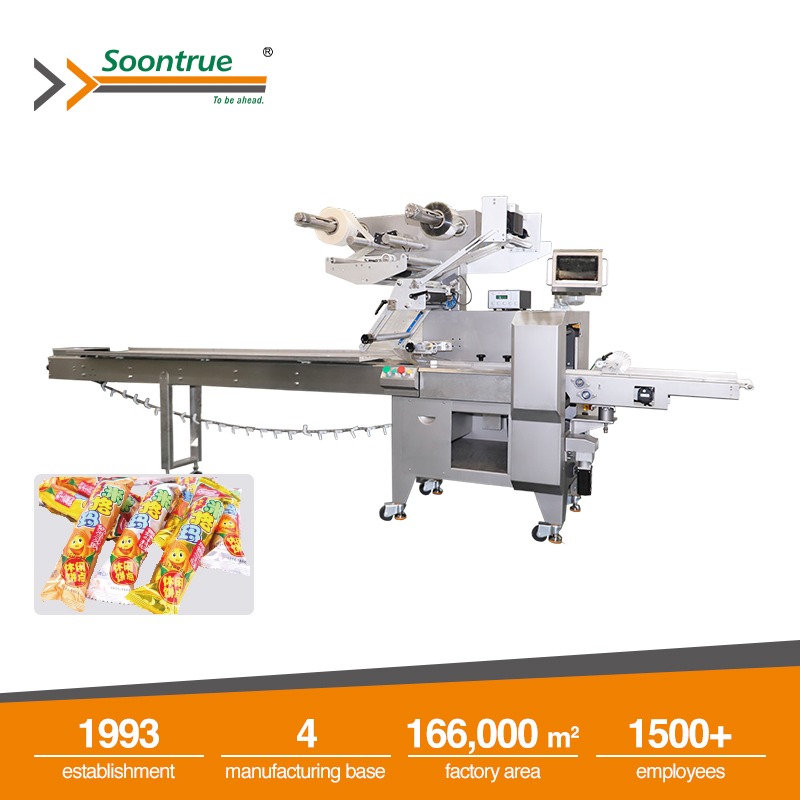
The packaging method must align with both the product’s characteristics and production objectives. Soontrue offers flow wrapping machines in both rotary and reciprocating (box-motion) configurations, catering to a wide range of products and sealing requirements. For bagged products, the choice between a vertical form-fill-seal (VFFS) machine or a pre-made bag packaging system depends on the specific product type and desired packaging format.
Furthermore, it is essential to consider the production processes that follow primary packaging. If the finished packages require subsequent operations—such as grouping, cartoning, or case packing—the downstream equipment must be capable of seamlessly integrating with the upstream output to prevent product accumulation.
|
Production stage |
Capacity question |
|
Feeding and weighing |
Can products or portions arrive consistently at the required rate? |
|
Primary packaging |
Can the machine maintain the target speed with the actual product and film? |
|
Cartoning or case packing |
Can the next stage handle the finished packages at the same pace? |
For a complete line, assess the practical throughput of each stage and identify the slowest constraint. That is a more reliable basis for equipment planning than comparing individual machines by their maximum speeds.
Consider Product Changes and Packaging Requirements
A production line dedicated to a single type of biscuit throughout an entire shift will likely yield a different output compared to a line that requires frequent changeovers between different products or packaging formats. Tasks such as replacing packaging film, adjusting equipment parameters, switching material supplies, and conducting quality checks all consume production time, thereby reducing the actual time available for manufacturing.
Before purchasing equipment, outline your primary products, packaging dimensions, types of packaging film, and the expected frequency of changeovers. If the production line must handle multiple product specifications (SKUs), evaluate how flexible and user-friendly the chosen equipment configuration is when adapting to these variations.
High operating speeds are meaningless if they result in poor package seals, product damage, or an excessive rejection rate. Productivity should be measured by the number of "compliant, finished, and packaged units"—not simply by the number of machine operating cycles.
Confirming the Capacity of Your Proposed Packaging System
Before finalizing equipment selection, confirm the following details with your packaging equipment supplier:
- Target output: Required packs per minute or per shift, along with available production time.
- Product specifications: Product dimensions, shape, weight, and feeding requirements.
- Packaging requirements: Bag format, film material, package dimensions, and sealing specifications.
- Line configuration: Compatibility between feeding, weighing, primary packaging, and downstream equipment.
- Performance verification: Test conditions, acceptable finished-pack quality, expected output, and changeover requirements.
Soontrue offers horizontal flow wrappers, vertical form-fill-seal machines, premade pouch packaging machines, and packaging configurations that can include downstream cartoning and case packing. The appropriate equipment combination depends on the product, package format, target output, and operating conditions.
Discussing these details before purchase helps establish a realistic capacity target and determine whether the proposed line can support the intended production requirements.
Conclusion
Accurate capacity planning helps prevent bottlenecks and improve packaging line performance. Consider production targets, operating time, and equipment compatibility before making a decision.
Contact Soontrue to discuss a packaging solution that fits your products and production requirements.