

Cartoning Machine Integration for Automated Packaging Lines
Cartoning machines need to work smoothly with upstream and downstream equipment. Proper integration helps manufacturers improve product handling and keep packaging processes running smoothly.
Why Cartoning Machine Integration Matters
Many factories start automation with individual packaging processes. They may already have horizontal or vertical packaging machines but still rely on workers to place finished products into cartons.
This can create several problems. Product feeding may become inconsistent, workers may struggle to keep up with packaging machines, and finished products can accumulate between production stages.
Integrating cartoning equipment helps connect these separate operations. Products can move from upstream packaging processes to carton loading with less manual handling.
However, successful integration depends on more than connecting conveyors. Product dimensions, feeding direction, carton specifications, and production speed all need to work together.
Key Factors Before Integrating Cartoning Equipment
Product Feeding and Positioning
Product feeding is one of the first things to check.
Products coming from upstream equipment need to reach the cartoning area in suitable positions. If products arrive too close together, overlap, or change direction unexpectedly, loading can become unstable.
This is especially important when handling products with different shapes or packaging formats.
Before selecting feeding equipment, manufacturers should confirm:
- Product dimensions and shape
- Product orientation after leaving upstream equipment
- Required spacing between products
- Whether products arrive individually or in groups
- How products should be positioned inside cartons
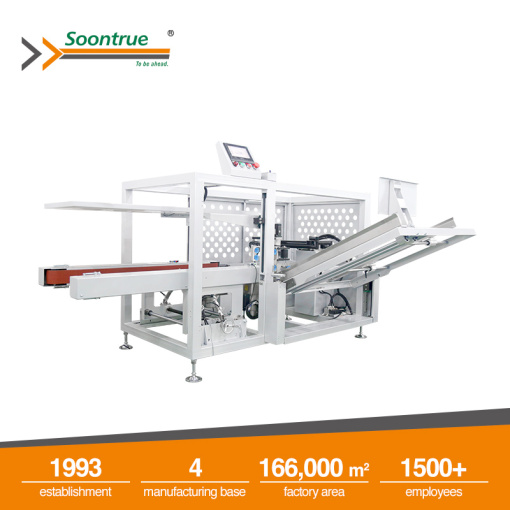
For applications involving different product orientations, robotic handling may also be worth considering. Soontrue's Robotic Case Erector Machine uses a manipulator to move and rotate products before placing them into cartons.
Carton Size and Packaging Compatibility
Product dimensions are only part of the selection process. Carton size and structure also affect how smoothly equipment operates.
Cartons that are too small may not accommodate products properly. Excessive empty space can also affect product presentation and packaging stability.
Manufacturers should prepare carton samples and confirm the following details before ordering equipment:
|
Item |
What to Confirm |
|
Carton dimensions |
Length, width, and height |
|
Carton structure |
Folding and closing style |
|
Product arrangement |
Single product or multiple products |
|
Carton material |
Material and folding performance |
|
Packaging requirements |
Glue flap or tuck flap |
Different carton structures may require different mechanical operations. Soontrue's ZH200 Cartoning Machine supports glue flap and tuck flap cartons, but these carton types require different machine configurations.
This is why carton samples should be checked before finalizing machine configuration.
Changeover Between Different Products
Factories producing several products often need to change carton sizes or product specifications.
Without suitable changeover arrangements, operators may spend too much time adjusting equipment. This can interrupt production and make scheduling more difficult.
Cartoning machines with suitable control systems and parameter memory can make repeated changeovers easier.
Soontrue's ZH200 features an HMI memory function for product and carton specifications. Operators can use saved settings when switching between production requirements.
Before purchasing, manufacturers should discuss how often they change products, how many carton sizes they use, and which adjustments need to be made manually.
Connecting Cartoning with Upstream and Downstream Equipment
Automated packaging lines usually include several connected stages. Cartoning equipment should be selected according to its role in the whole process.
Connecting with Upstream Packaging Machines
Products may arrive from horizontal packaging machines, vertical packing machines, or other production equipment.
The connection needs to account for product discharge position, conveyor direction, transfer distance, and feeding stability.
For example, Soontrue's ZH200 is designed to work with horizontal and vertical packaging machines as part of automated production lines.
When discussing integration, manufacturers should provide upstream machine models, product samples, and actual production requirements. This gives equipment suppliers clearer information about the connection needed.
Connecting with Downstream Case Packing Equipment
After products enter individual cartons, some factories need another packaging stage to load those cartons into outer cases.
This is where case packing equipment serves a different purpose from cartoning machines.
The two machines handle different packaging levels. Cartoning equipment prepares individual product cartons, while robotic case packing equipment handles secondary packaging.
For manufacturers planning complete packaging lines, these stages should be considered together rather than purchased as unrelated machines.
What Should Manufacturers Confirm Before Installation?
Before placing an order, buyers should prepare enough information for manufacturers to evaluate actual production requirements.
|
Information |
Why It Matters |
|
Product samples |
Confirms product shape and handling requirements |
|
Product dimensions |
Helps determine feeding and loading arrangements |
|
Carton samples |
Checks carton size and closing structure |
|
Existing equipment |
Helps plan upstream and downstream connections |
|
Production requirements |
Helps evaluate machine configuration |
|
Workshop layout |
Helps determine equipment placement and conveyor direction |
It is also worth discussing installation space, operator access, cleaning, and maintenance before finalizing the layout.
Equipment may meet product requirements but still create difficulties if there is not enough room for material loading, inspection, or daily maintenance.
Conclusion
Soontrue provides cartoning machines, robotic case packing machines, and other packaging equipment for different production needs. Share your product and carton specifications with our team to discuss suitable solutions for your production line.
Contact Soontrue to discuss your packaging requirements.
FAQs
Can cartoning machines connect directly to existing packaging machines?
It depends on product discharge arrangements, feeding methods, machine configurations, and available workshop space. Existing equipment models and product samples should be reviewed before confirming the connection.
What information should I provide when requesting cartoning equipment?
Prepare product dimensions, product samples, carton drawings or samples, required packaging formats, and details of existing production equipment. These details help manufacturers evaluate suitable machine configurations.
Can one cartoning machine handle different carton sizes?
This depends on the machine model and its adjustment range. Buyers should confirm carton dimensions and changeover requirements with manufacturers before ordering.
Is cartoning equipment the same as case packing equipment?
No. Cartoning machines place products into individual cartons. Case packers handle secondary packaging, such as loading products or cartons into outer cases.