

Full-Servo Control in Flow Wrapping: Improving Automatic Packaging Line Performance
Full-servo technology has become a core driver of modern food packaging automation. It delivers precise motion control, lower waste, and higher overall equipment effectiveness. This article examines how full-servo flow wrapping systems strengthen automatic packaging lines and support better operational results.
Why Full-Servo Control Matters in Automatic Packaging Systems
Limitations of Mechanical and Frequency-Controlled Systems
Traditional mechanical or frequency-controlled flow wrappers rely on cams, chains, and fixed gearing. These components wear over time and limit flexibility. Full-servo systems replace most mechanical linkages with independent servo motors. Each axis—film feed, end sealing, cross sealing, and product infeed—operates under precise digital control.
Advantages of Independent Servo Axes
The result is better synchronization across the entire packaging process. Machines maintain consistent bag length, seal quality, and timing even when speeds change or products vary. This capability is essential for integrated automatic packaging lines where upstream and downstream equipment must stay coordinated.
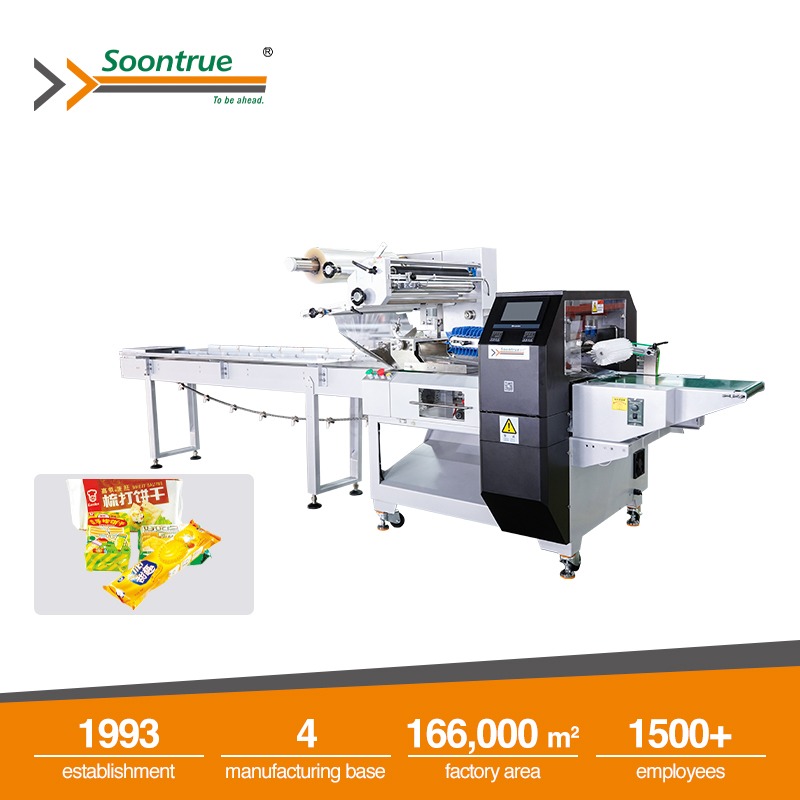
Full-servo control also supports advanced functions that mechanical machines cannot match. These include automatic recipe recall, packless operation, and cutless protection. Together they reduce downtime and material waste while raising line reliability.
Key Performance Benefits of Full-Servo Flow Wrappers
Film Waste Reduction
Full-servo machines improve three critical areas of packaging line performance: waste reduction, changeover speed, and overall equipment effectiveness.
Film waste reduction stands out as one of the strongest returns. Sensors detect missing or misplaced products. The machine pauses film feed and cutting until the next valid product arrives. This “no product, no bag” function prevents empty packages. Industry data shows film savings of 12–30% compared with older mechanical systems, depending on starting conditions and product mix.
Faster Changeovers
Changeover time drops dramatically. Operators select a stored recipe on the HMI touchscreen. Servo motors automatically adjust bag length, sealing positions, and speeds. Typical changeovers take 2–5 minutes instead of 20–45 minutes on mechanical machines. Faster changeovers directly improve availability—the largest component of OEE in multi-SKU plants.
Higher Overall Equipment Effectiveness
Overall Equipment Effectiveness rises because the machine runs more continuously with fewer micro-stops. Well-engineered full-servo flow wrappers commonly achieve sustainable OEE in the 85–94% range at higher speeds. Older mechanical lines often operate in the 65–75% range under similar conditions.
|
Performance Factor |
Mechanical / Frequency Control |
Full-Servo Control |
|
Film waste on missing products |
High (empty bags produced) |
Minimal (packless function) |
|
Typical changeover time |
20–45 minutes |
2–5 minutes |
|
Seal consistency at speed |
Drifts with wear |
Maintained by digital feedback |
|
Maintenance frequency |
Higher (chains, gears, cams) |
Lower (fewer wear parts) |
|
Sustainable OEE range |
65–75% |
85–94% |
These gains compound across a full automatic packaging line. When the primary flow wrapper runs with higher availability and less scrap, downstream case packing and palletizing equipment also perform more efficiently.
Enabling Technologies That Support Line Integration
Synchronization and Communication Capabilities
Full-servo flow wrappers integrate more easily into complete automatic packaging systems. Independent servo axes communicate through standard industrial protocols. This allows precise handshakes with automatic feeding systems, checkweighers, cartoners, and robotic case packers.
Precision Tracking and Protective Functions
Color-mark tracking accuracy reaches 0.1 mm on advanced models. This precision keeps printed films correctly registered and supports high-quality branding without frequent manual adjustments. Shaftless drive designs eliminate mechanical joints, reducing vibration and simplifying maintenance.
Many full-servo machines also include cutter torque protection and automatic film splicing. These features prevent damage from hard objects and allow film roll changes without stopping the line. Both functions support continuous operation in integrated systems.
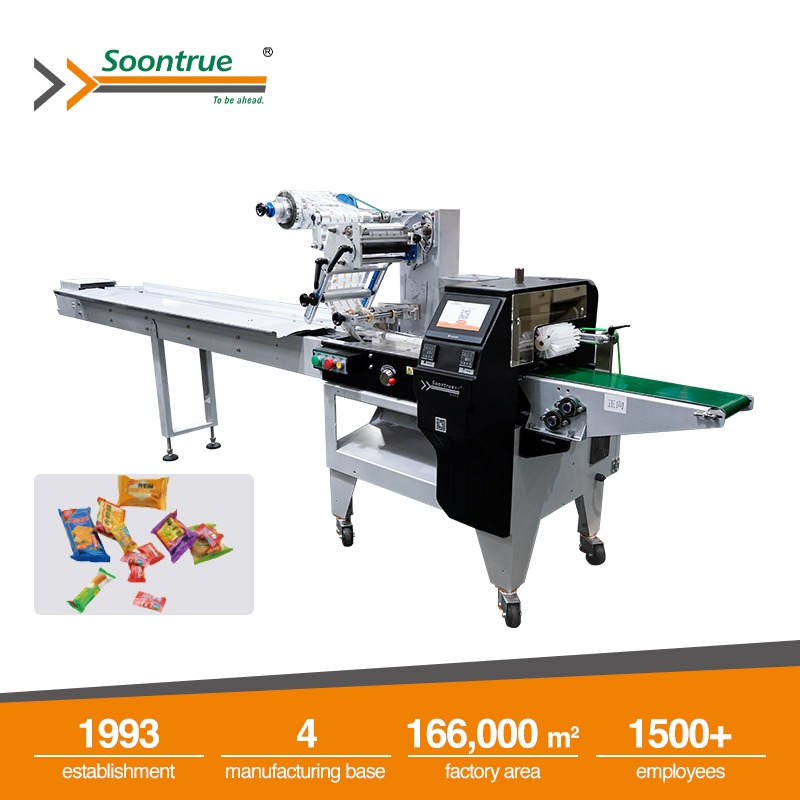
Models such as the SZ602W full-servo flow wrapping machine illustrate these capabilities. Its multi-axis servo architecture, packless function, and recipe-driven controls make it suitable for synchronized automatic lines. Larger-format options like the SZ601 big pillow bag flow wrapping machine extend the same servo advantages to bulkier or irregular products while remaining compatible with automatic feeding systems.
For a broader view of available configurations, see the Flow Packaging Machine category.
Common Purchasing Concerns and Practical Answers
Initial Cost Versus Long-Term Value
Buyers evaluating full-servo flow wrappers often raise similar questions. Addressing them clearly helps decision-makers move forward with confidence.
Full-servo machines carry a higher purchase price than basic mechanical models. However, film savings, labor reduction, and higher OEE typically deliver payback within 12–18 months in multi-shift operations. Total cost of ownership favors servo technology once waste and downtime are included.
Ease of Operation and Training
Modern HMI interfaces store product recipes and guide operators through adjustments. Most daily tasks require only start/stop buttons and recipe selection. Training time is shorter than with mechanical machines that need skilled adjustment of cams and gears.
Integration with Existing Equipment
Full-servo systems are designed for connection to upstream formers, feeders, and downstream secondary packaging. Open communication protocols and modular designs simplify integration into both new and existing automatic packaging lines.
Maintenance, Reliability, and Sustainable Films
Fewer mechanical wear parts mean lower routine maintenance. Digital feedback loops maintain accuracy without frequent recalibration. Predictive diagnostics on advanced systems further reduce unplanned stops.
Precise temperature and dwell control allow reliable sealing of thinner and mono-material films. This capability supports packaging waste reduction goals without sacrificing speed or seal integrity.
From Standalone Machine to Integrated Automatic Line
Starting with a Single High-Performance Wrapper
Many plants begin with a single high-performance flow wrapper. Full-servo technology makes the later expansion path smoother. Because motion parameters are digital and repeatable, the same machine can later synchronize with additional feeders, inspection systems, or end-of-line robotics.
Scaling Toward Fully Automatic Systems
This modular growth approach reduces risk. Production managers can prove performance on one SKU or product family, then scale the system as volume or variety increases. The result is a progressive path toward fully automatic packaging lines without requiring a complete line replacement at the start.
Plants that treat the flow wrapper as a system component—rather than an isolated machine—achieve the highest returns. Synchronization with upstream product handling and downstream secondary packaging eliminates many of the micro-stops that limit overall line efficiency.
Practical Steps for Evaluating Full-Servo Flow Wrapping
Key Evaluation Criteria
When assessing options for an automatic packaging line, focus on measurable criteria:
- Confirm independent servo control on all major axes
- Verify packless and cutless protection functions
- Test recipe changeover time with your actual products
- Review film consumption data under realistic running conditions
- Check communication capability with existing or planned upstream and downstream equipment
- Evaluate hygienic design features for food environments
The Value of Real Product Trials
Request a packaging trial with your product and film. Real test results provide clearer evidence of seal quality, waste levels, and speed capability than specifications alone.
Explore additional technical resources and system-level guidance in the Food Automatic Packaging Solutions collection.
Full-servo control transforms flow wrapping from a standalone process into a high-performance element of automatic packaging systems. It reduces waste, shortens changeovers, raises OEE, and simplifies integration. Plants that adopt this technology position their packaging lines for higher reliability and lower operating cost over the long term.
Upgrade your production line today with Soontrue's advanced full-servo flow wrapping machines. Visit our website to explore our automated packaging solutions and contact our experts for a tailored consultation.