
What happens when a high-performing packaging line reaches the final stages of production, but carton preparation and pallet stacking still rely on manual operations?
For many food manufacturers, improving primary packaging speed is only part of the automation challenge. Case erecting, case packing, sealing, and palletizing also need to operate reliably to support the overall production process.
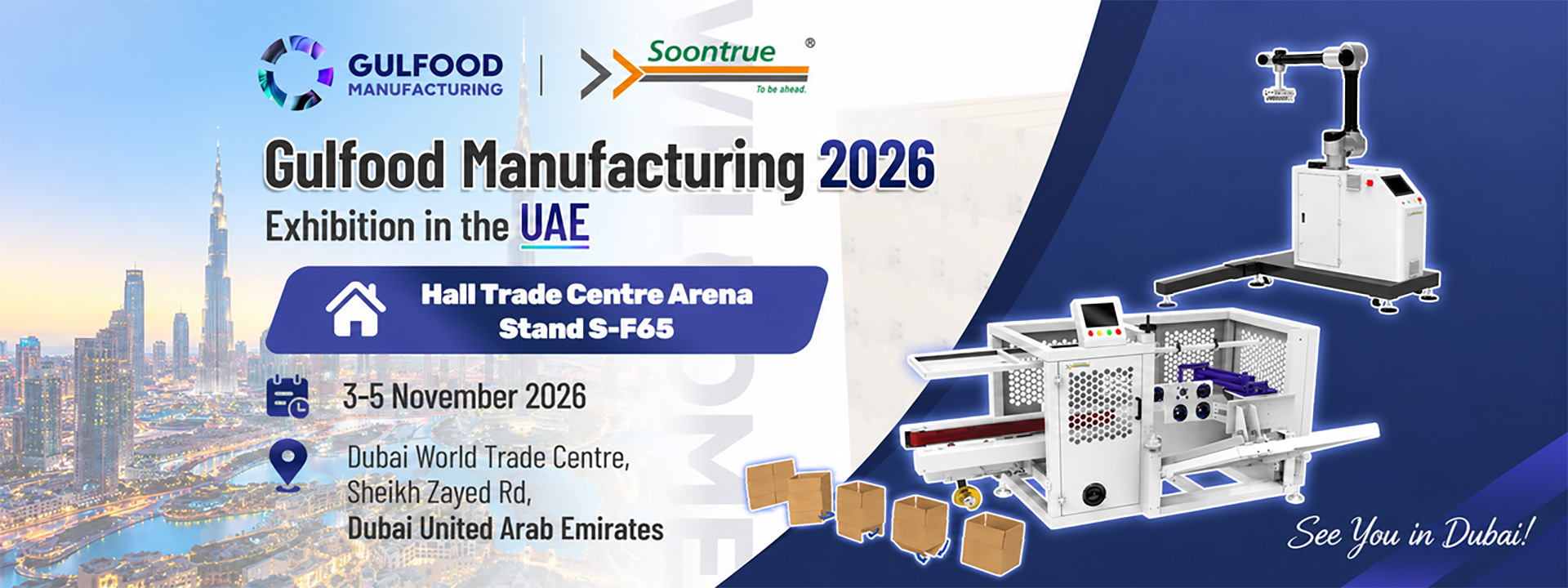
At Gulfood Manufacturing 2026 in Dubai, Soontrue Machinery will highlight practical approaches to end-of-line packaging automation through two featured machines: the TKXM500 Automatic Case Erector and WP30 Collaborative Palletizer.
Visit us at Trade Centre Arena, Stand S-F65, from November 3–5, 2026, to discuss how automated case handling and palletizing can support your production goals.
Exhibition Information
Event: Gulfood Manufacturing 2026
Dates: November 3–5, 2026
Venue: Dubai World Trade Centre, United Arab Emirates
Booth: Trade Centre Arena, Stand S-F65
Featured Equipment: TKXM500 Case Erector and WP30 Collaborative Palletizer
Why End-of-Line Packaging Automation Matters
A production line may package products efficiently while still experiencing delays at the secondary packaging stage.
Operators may need to prepare corrugated cases, manage incoming cartons, handle finished cases, and stack them onto pallets. When these processes are poorly coordinated, production flow can become inconsistent.
End-of-line packaging automation addresses these challenges by connecting individual handling operations into a more organized process.
Depending on production requirements, an automated end-of-line system may include:
- 1. Automatic case erecting
- 2. Product grouping and case packing
- 3. Carton sealing and conveying
- 4. Robotic palletizing
- 5. Pallet transfer to warehouse operations
Each stage must be configured according to the product, package format, required speed, and factory layout.
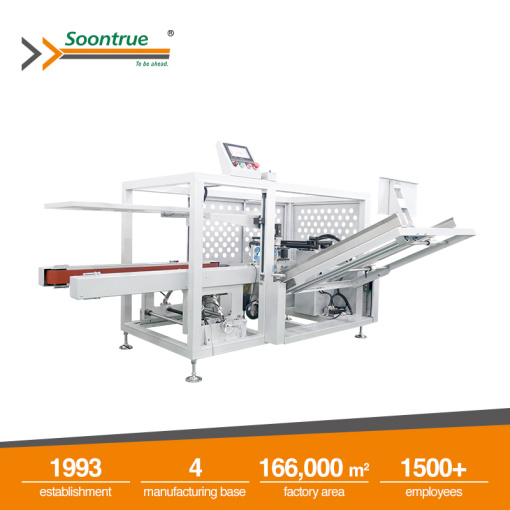
TKXM500: Automatic Case Erecting for Consistent Carton Supply
Case erecting is an essential starting point for many secondary packaging lines.
The TKXM500 Automatic Case Erector is designed to help prepare corrugated cases before products are loaded into them.
Automating this operation can reduce manual handling and help maintain a consistent case supply for downstream equipment.
However, selecting a case erector requires more than choosing a machine based on speed.
Manufacturers should review carton board quality, box dimensions, forming requirements, sealing method, and the relationship between case supply and downstream packing capacity.
When these factors are evaluated together, case erecting automation can support a more coordinated packaging process.
WP30: Collaborative Palletizing for Finished Cartons
After products have been packed and sealed in shipping cases, the final packaging stage often involves palletizing.
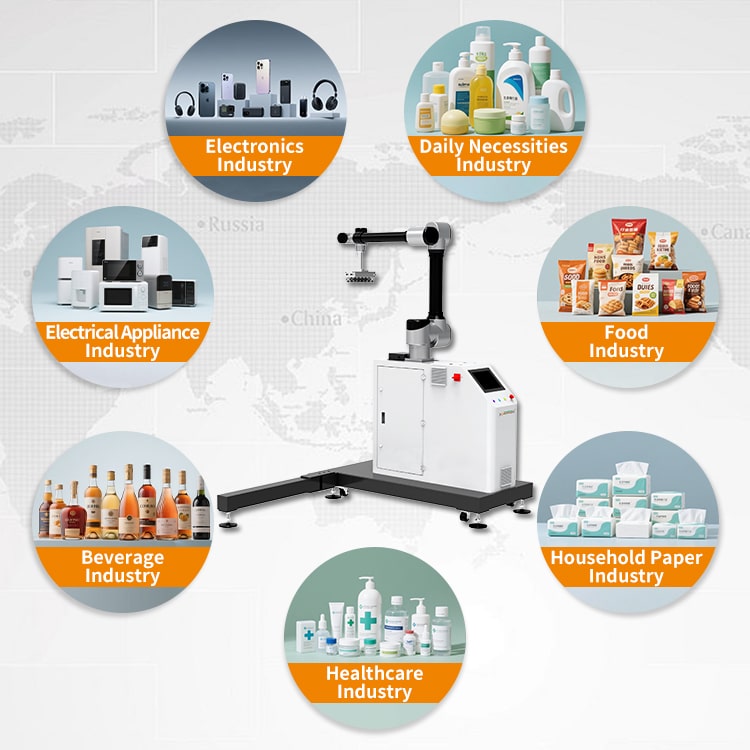
The WP30 Collaborative Palletizer is designed to pick and stack cartons according to the selected palletizing arrangement.
It can help manufacturers reduce repetitive manual stacking while maintaining more consistent pallet patterns.
During system planning, important factors include carton weight, stacking height, pallet dimensions, incoming conveyor arrangement, and required operating speed.
Multiple carton formats may also require suitable gripping configurations and palletizing recipes.
The WP30 can be evaluated as an independent palletizing solution or as part of a broader end-of-line packaging project.
How Can Case Erecting and Palletizing Work Together?
Automatic case erecting and collaborative palletizing perform different functions, but both contribute to an efficient secondary packaging workflow.
A typical process may begin with corrugated cases being formed by the TKXM500. Products are then loaded and the cases sealed by compatible downstream equipment.
Finished cases travel along a conveyor before reaching the WP30 palletizing station, where they are arranged onto pallets according to the required pattern.
The TKXM500 and WP30 are the featured machines at the exhibition. Intermediate case packing, sealing, and conveying equipment may be considered during solution planning according to the project scope.
This distinction helps manufacturers understand how the individual machines fit into a larger automation system without assuming that every module is included in the displayed equipment.
Applications for Food Manufacturing Facilities
End-of-line packaging systems can support a wide range of manufacturing environments, including:
- Bakery and biscuit production
- Snack and confectionery packaging
- Frozen and processed food lines
- Beverage and packaged-food distribution
- Household and consumer product packaging
The main design considerations are the physical characteristics of the shipping cases, production output, pallet requirements, and available installation space.
What Should Manufacturers Prepare Before Discussing Automation?
A successful automation project begins with an accurate understanding of the current production process.
Before meeting our team, we recommend preparing the following information:
- Finished carton dimensions and weight
- Cartons per minute or hour
- Current case erecting and palletizing methods
- Pallet dimensions and required stacking patterns
- Available factory space
- Planned production expansion or changeover requirements
This information allows engineers to evaluate machine suitability, identify possible bottlenecks, and discuss an appropriate equipment configuration.
FAQ
Q1: What is end-of-line packaging automation?
It refers to automating downstream operations such as case forming, case packing, carton sealing, conveying, and palletizing after primary product packaging.
Q2: Can existing packaging lines be upgraded without replacing all equipment?
In some cases, individual modules can be added to existing lines. Compatibility depends on the mechanical layout, controls, product handling, and operating speed.
Q3: Can a collaborative palletizer handle different carton sizes?
Different carton formats may be supported within a defined operating range. Gripper suitability, weight limits, pallet patterns, and changeover requirements must be evaluated.
Q4: Where can I discuss a packaging automation project with Soontrue?
Visit Trade Centre Arena, Stand S-F65, during Gulfood Manufacturing 2026 in Dubai.
Discuss Your End-of-Line Packaging Project in Dubai
Whether you need to automate a single carton-handling task or are planning a more integrated secondary packaging system, Soontrue welcomes you to discuss your project.
Visit Stand S-F65, November 3–5, 2026, and share your packaging line requirements with our team.
Discuss Your Automation Project | Book a Technical Meeting